
Auto Repair Forum: What to do if you get a flat tire? Can you DIY a tire repair? Detailed steps will guide you through the process.


We've previously discussed the relationship between tires and safety, and written about how to check tire tread wear, and most importantly, how to manage tire pressure. However, if your tire keeps leaking air no matter how much you inflate it, or if you feel a tire vibrating violently while driving, or even hear a leaking sound, then your tire is likely punctured and leaking air. What should you do? Should you take it to a motorcycle repair shop or a car tire shop? What if you happen to be in a remote area and can't find a tire shop? This article teaches you how to patch your tire yourself—it's much simpler than you think, really.
Don't understand tires? This article provides a very detailed explanation:
Types of tire repair
Some people have heard that tire repair involves internal and external methods, right? In fact, there are many different ways to repair a tire! From the simplest tire repair patches and liquid, to internal repairs using a mushroom-shaped patch, external repairs using a tire repair strip (insertion patch), and the most troublesome but also the most effective large tire repair patch which uses a burn-in method.
If conditions permit, my favorite is the mushroom-shaped internal patch. Later, the manufacturer also developed an external mushroom-shaped internal patch, which is even more effective, but it requires a very large mushroom-shaped internal patch tool, and it is rarely seen in general stores except for professional tire shops.
Regarding tire sealant, as a weekend mechanic, I suggest: Although car manufacturers are gradually stopping including spare tires and replacing them with tire sealant kits that come with an air pump, tire sealant can easily clog the tire pressure monitoring system. Also, after removing the tire and needing to replace it, there's a painful rim cleaning process, and tire shops might refuse to do the work or charge extra. Therefore, it's best to use tire sealant sparingly.
This article mainly explains how to repair a tire using the insert patch method, which is easy for most people to operate, effective, and almost universal. While insert patching was initially thought to be prone to leaks, it usually prevents leaks if the procedure is performed correctly.
Note: This explanation applies only to tubeless high-speed tires for regular cars and motorcycles. Runaway tires, truck tires, bicycle tires, and special tire types for agricultural or construction machinery are not covered in this explanation.
Tool and Material List
Here is a list of essential tools and materials for tire repair. Ideally, each vehicle should have a set, especially motorcycles that lack a spare tire. I belong to a motorcycle team in northern Taiwan, and we always have the opportunity to get a tire repaired while traveling each year.
Also, don't buy those threaded or open-faced diamonds that aren't T-shaped! They're very difficult to apply force with; unless you're extremely confident in your wrist strength, you simply can't drill into them. I still recommend buying T-shaped ones.
In addition, the best pliers for removing foreign objects are diagonal pliers, but they are easy to damage and can easily injure the tire sidewall, so they are not recommended in the tool list and are only for those who consider themselves to be skilled.
As for tire repair strips, those very wet glue-free tire repair strips are really difficult to use. When you pick them up or thread them through the puncture hole, your hands will be covered in glue. I suggest buying traditional tire repair strips, which are easier to handle and easier to mold.
Finally, an electric tire inflator that plugs into a cigarette lighter is actually the best option. Cordless inflators, when dealing with a puncture tire that needs to be repaired from almost zero pressure to 35 PSI, often run out of power before achieving the necessary pressure. The same applies to high-pressure cylinders; it's uncertain whether six cylinders would be enough to fully inflate a motorcycle tire. High-pressure cylinders should only be used for bicycle tire repairs; never use them for car or motorcycle tire repairs.
Note: DIY always carries certain risks. If you are not familiar with vehicle repair operations, it may cause an accident. It is recommended that you have the relevant knowledge or license.

▲With the tools and materials ready, there's no need to worry about patching a tire.

▲Tire repair kits sold online
What types of tire punctures can be repaired?
Tire punctures, such as those with nails, screws, or any holes smaller than 6mm in diameter, can be repaired. How can you tell when someone is outside? According to data from the Central Mint, the diameter of a one-yuan coin is 20mm . The neck of Chiang Kai-shek on the coin is approximately 6.4mm thick.
So, anyone whose neck is smaller than Chiang Kai-shek's can probably get it done, but it's not recommended for those who are larger.
Additionally, it is not recommended to repair the tire if the sidewall or the shoulder where the tread meets the sidewall is damaged. For example, it is not recommended to repair the tire if it is a crack or a long puncture.

▲How to determine if a tire can be repaired? Take out a one-dollar coin and measure it with Chiang Chung-cheng's neck. Tires larger than 6mm are not recommended for repair.
How is tire repair performed?
Repairing a tire isn't difficult, really. It roughly involves a few steps: removing foreign objects, smoothing the puncture, inserting a patch soaked in glue, removing the drill bit, inflating the tire, checking for leaks, and cutting off the protruding part of the patch. We'll explain in detail below:
Remove foreign objects
This step is relatively simple. First, remove nails, screws, or any foreign objects puncturing the tire from the tread. You may need tools such as needle-nose pliers, diagonal pliers, or a screwdriver. I personally use needle-nose pliers most often. It's important to note that if the inserted foreign object is a screw or similar threaded object, try to unscrew it with a tool to avoid pulling it out forcefully, which could further damage the tire tread.
In addition, when removing foreign objects, the air in the tires will often be released at high speed due to tire pressure. It is best to wear goggles to avoid getting anything in your eyes.

▲ First, remove nails, screws, or any foreign objects that have punctured the tire. The threads of this screw are almost worn down, so you can only slowly turn it off with needle-nose pliers.

▲ The screw that was just pulled out. It looks like there's a big hole, but the actual diameter of the screw insertion point is less than 4mm.
Grinding the broken surface
Next, remove the thread drill and smooth the puncture surface back and forth. Modern high-speed tires have a steel wire layer inside the tread. The main purpose of smoothing is to flatten the steel wire and the contact surface with the patch, allowing the patch to adhere properly to the contact surface. Don't be surprised if you see metal shavings from the steel wire during the smoothing process.

▲ At this point, you need to carefully polish the tear to make it smooth.
Applying adhesive to the tire repair strip and inserting it into the puncture.
This step looks simple, but it's often the easiest to get stuck on.
First, take out the adhesive strip, then flatten the tip, and slowly try to thread it through the hole in the drill bit. Those who have sewn clothes will understand; it's like threading a needle. The difference is that the adhesive strip is sticky, especially those glue-free tire repair strips. Although convenient, this step will definitely leave your hands covered in glue, which looks unsightly.
After passing the tape through the slit drill, apply a little super glue or rubber adhesive to both the tape and the slit.
Finally, simply rotate the drill bit with the rubber strip inserted and insert it into the opening, and when it is more than halfway inserted, pull it straight up.

▲At this point, you need to prepare adhesive strips, glue, and a drill bit.

▲After finally getting the tape through the open drill bit, you need to apply glue.

▲When inserting the tire patch, slowly "rotate" it in to ensure that the puncture is completely covered by the patch.

▲When pulling out an open drill bit, it must be pulled out "straight" for easier removal.
Inflation, leak detection and completion
After inserting the patch into the puncture, the next step is to inflate the tire and check for leaks. At this point, take out your air pump or electric air compressor. Inflate the tire to the manufacturer's recommended pressure. Next, spray some soapy water onto the puncture site.
What if you're unlucky enough to be outside and don't have soap on your hands? You can go to a gas station or any place where you can use the restroom and ask for some hand soap. Apply some of the hand soap to a paper towel and bring it over, then add a little water and apply it to the cut.
If the leak persists after patching, check if you missed a step during the repair. Common mistakes include not smoothing the puncture, forgetting to apply adhesive before inserting the patch, or not rotating the patch properly during insertion.
After applying soapy water, if you don't see any signs of leaking (i.e., no large bubbles), you're done. At this point, simply cut off the protruding part of the tire patch, and you can continue driving. It's important to note that it's recommended to drive at a slightly lower speed (e.g., 1-2 kilometers) immediately after patching to check for leaks again. If there are no leaks, you can drive safely. Some people park their cars immediately after patching and refuse to drive further, which is a mistake.
Although tire repair strips are coated with adhesive and have some stickiness, they still require the wheel to rotate and even heat up to completely seal the puncture. Therefore, I recommend driving at low speed for a short distance after tire repair to complete the repair. However, I do not recommend driving directly on the highway, because if the repair is not done properly, or if the tire repair strip itself is of poor quality and detaches, the tire will leak air at high speed, which is extremely dangerous.

▲The first thing to do after patching a tire is to check for leaks. You must inflate the tire fully first.

▲Soapy water can be used to detect leaks, as it makes them easier to spot.
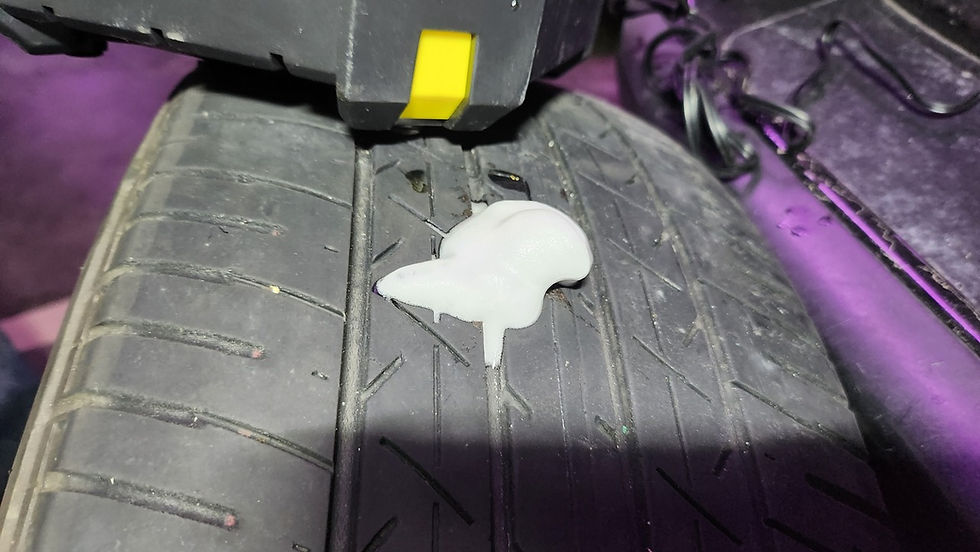
▲ Although household soapy water foams, as long as you don't see the bubbles gradually growing larger, it means there is no air leakage.

▲Note that the tire pressure test is only meaningful if the tires are fully inflated. There will be no leaks when there is no tire pressure.

▲Once you've confirmed there's no air leak, cut the protruding tire patch flush with the tire tread. This will prevent the patch from being pulled out completely later.

▲The completed photo shows that although the colors are different, the tire tread has now been restored to a smooth surface.


Comments